
Every driver faces the question: Can my vehicle handle this load? Whether you’re planning a weekend camping trip with a travel trailer, hauling equipment for work, or moving across the country, understanding your vehicle’s maximum weight you can tow isn’t just about getting from point A to point B—it’s about arriving safely and legally.
Exceeding your vehicle’s towing capacity risks catastrophic mechanical failure, hefty fines, insurance claim denials, and most critically, accidents that can endanger lives. The consequences of overloading extend far beyond a damaged transmission or blown engine. In 2023 alone, improper towing contributed to thousands of roadside breakdowns and accidents across Michigan highways, including major routes near Benton Harbor.
Why Towing Limits Matter
Your vehicle’s maximum tow weight isn’t a suggestion—it’s a engineered safety threshold. Manufacturers determine these limits through rigorous testing that considers engine cooling, transmission durability, brake performance, and structural integrity. When you exceed these limits, you’re operating outside the safety envelope that engineers designed to protect you and other drivers.
This comprehensive guide provides step-by-step instructions for calculating your true towing capacity, understanding legal requirements, and making informed decisions that keep you compliant and safe on the road.
Understanding Towing Capacity Basics
Before hitching up any load, you must understand the fundamental weight ratings that determine how much your vehicle can safely tow.
Key Weight Ratings Explained
GVWR (Gross Vehicle Weight Rating) represents the maximum allowable weight of your fully loaded vehicle, including passengers, cargo, and fuel. This rating appears on a label inside your driver’s door frame and forms the foundation for all towing calculations.
GCWR (Gross Combined Weight Rating) defines the maximum total weight of your vehicle plus trailer when fully loaded. This critical number determines your absolute maximum tow weight under ideal conditions.
GAWR (Gross Axle Weight Rating) specifies the maximum weight each axle can support. Front and rear axles typically have different ratings, and exceeding either limit creates dangerous handling characteristics and accelerated wear.
Understanding these three ratings allows you to calculate your actual towing capacity using this formula: Maximum Tow Weight = GCWR – Actual Vehicle Weight (including passengers and cargo).
Factors Affecting Maximum Tow Weight
Your vehicle’s maximum weight you can tow depends on multiple interconnected factors that work together to determine safe operating limits.
Vehicle type significantly impacts towing capacity. Half-ton pickup trucks typically tow 7,000-12,000 pounds, while heavy-duty trucks can handle 15,000-35,000 pounds. SUVs generally fall between 3,500-9,000 pounds, depending on size and powertrain configuration.
Engine power and torque directly influence towing performance. Higher torque ratings provide better pulling power, especially when accelerating from stops or climbing hills. Diesel engines typically offer superior towing capacity compared to gasoline engines of similar displacement.
Transmission and drivetrain configuration affect both capacity and durability. Automatic transmissions with tow modes, manual shift capabilities, and integrated trailer brake controllers enhance towing performance. Four-wheel drive systems distribute power more effectively but may reduce maximum tow ratings due to increased vehicle weight.
Hitch class and configuration create physical limitations. Class I hitches handle up to 2,000 pounds, Class II supports 3,500 pounds, Class III manages 5,000 pounds, Class IV handles 10,000 pounds, and Class V supports up to 12,000 pounds for weight-distributing hitches.
Legal and Manufacturer Limits
Manufacturer tow ratings represent maximum safe capacity under ideal conditions with a 150-pound driver and minimal cargo. Real-world towing capacity decreases as you add passengers, luggage, and equipment to your vehicle.
DOT and state-specific regulations establish legal requirements that may be more restrictive than manufacturer ratings. Michigan requires trailer brakes on loads exceeding 3,000 pounds and mandates specific lighting configurations for trailers over certain widths.
Insurance considerations become critical when exceeding limits. Many policies exclude coverage for accidents involving overloaded vehicles, leaving you personally liable for damages and injuries.
Immediate Safety Checks Before Towing
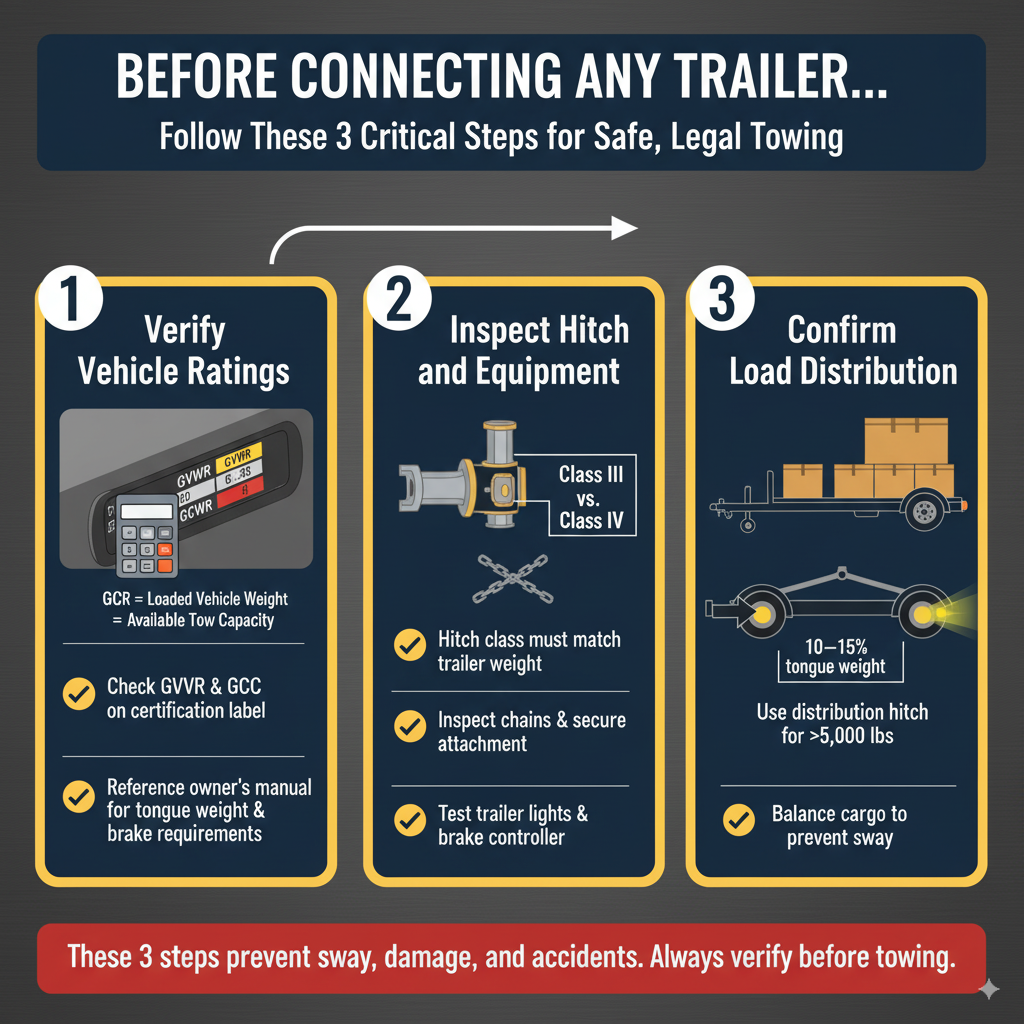
Before connecting any trailer, complete these essential verification steps to ensure safe, legal towing.
Step 1 → Verify Vehicle Ratings
Locate your vehicle’s GVWR and GCWR on the certification label inside the driver’s door frame. This yellow and black label contains official weight ratings that supersede marketing materials or online specifications.
Reference your owner’s manual for complete towing specifications, including maximum tongue weight, trailer brake requirements, and special equipment recommendations. Many manufacturers provide detailed towing guides with model-specific information.
Calculate your available towing capacity by subtracting your loaded vehicle weight from the GCWR. Remember that passengers, fuel, cargo, and aftermarket accessories all reduce your maximum tow weight.
Step 2 → Inspect Hitch and Equipment
Verify that your hitch class matches or exceeds your trailer’s loaded weight. A Class III hitch cannot safely tow a 7,000-pound trailer, regardless of your vehicle’s rated capacity.
Inspect safety chains for proper grade ratings, secure attachment points, and correct crossing pattern underneath the trailer tongue. Chains should support the full trailer weight and prevent separation if the primary hitch fails.
Test trailer lighting systems, including turn signals, brake lights, and hazard flashers. Confirm that your brake controller is properly calibrated for your trailer’s braking system.
Step 3 → Confirm Load Distribution
Maintain proper tongue weight between 10-15% of total trailer weight for conventional hitches. Insufficient tongue weight causes dangerous trailer sway, while excessive tongue weight overloads your rear axle and reduces steering control.
Consider weight-distributing hitches for trailers exceeding 5,000 pounds. These systems transfer tongue weight to your front axle and trailer axles, improving stability and maintaining proper vehicle geometry.
Balance cargo within your trailer to prevent weight concentration at the rear, which shifts the center of gravity and increases sway tendency.
Real-World Scenarios
Understanding how towing limits apply in practical situations helps you make informed decisions across different applications.
Light-Duty Towing (Cars, Small Trailers)
Passenger cars and compact SUVs typically handle small utility trailers, lightweight boats, and motorcycle trailers effectively. Maximum capacities usually range from 1,500-5,000 pounds depending on engine and transmission configuration.
Focus on proper hitch installation, adequate cooling system capacity, and trailer brake requirements. Even light loads benefit from transmission coolers and brake controllers in stop-and-go traffic.
Medium-Duty Towing (RVs, Boats, Equipment)
Mid-size trucks and SUVs excel at towing travel trailers, boat trailers, and construction equipment within their rated capacities. These applications demand attention to ground clearance, turning radius, and braking performance.
Plan routes carefully to avoid low-clearance bridges, steep grades that exceed your vehicle’s capabilities, and narrow roads that complicate maneuvering. Consider fuel consumption increases of 25-50% when towing in this weight range.
Heavy-Duty & Commercial Towing
Heavy-duty trucks and commercial vehicles handle the largest trailers and equipment loads. Semi-trucks can legally tow up to 80,000 pounds gross combined weight on interstate highways, while specialized permits allow even heavier loads.
Commercial operators near 1303 M-139, Benton Harbor, MI 49022, United States regularly navigate weight restrictions on local bridges and industrial routes. Professional drivers understand that legal weight limits may differ from vehicle capacity, requiring careful route planning and permit compliance.
Interstate trucking through Michigan requires thorough knowledge of bridge laws, weigh station procedures, and seasonal weight restrictions during spring thaw periods.
Risks of Exceeding Maximum Tow Weight
Operating beyond your vehicle’s maximum weight you can tow creates cascading risks that affect safety, reliability, and legal compliance.
Mechanical Damage
Engine and transmission overheating occurs when cooling systems cannot dissipate the additional heat generated by overloading. Transmission fluid breakdown, torque converter damage, and engine bearing failure result from prolonged overheating conditions.
Suspension and brake system stress accelerates component wear and reduces service life. Overloaded vehicles experience premature brake pad wear, suspension bushing failure, and tire damage from excessive weight concentration.
Frame stress and hitch failure become significant risks when exceeding design limits. Manufacturer warranties typically exclude coverage for damage resulting from overloading.
Safety Hazards
Reduced stopping distance increases accident risk, especially in emergency situations. Overloaded vehicles require significantly more distance to stop safely, and trailer brakes may not provide adequate supplemental braking force.
Increased rollover and jackknife risk results from altered vehicle dynamics and center of gravity changes. Overloaded trailers create unstable handling characteristics that experienced drivers struggle to control.
Wind sensitivity increases dramatically with overloading, making highway driving dangerous in crosswind conditions.
Legal and Financial Consequences
Fines and citations for overweight violations range from hundreds to thousands of dollars, depending on the degree of overloading and jurisdiction. Commercial drivers face additional penalties including license suspension and CSA score impacts.
Insurance claim denials leave you financially responsible for accident damages when operating overloaded vehicles. Personal injury lawsuits can result in significant financial liability when overloading contributes to accidents.
DOT inspections and weigh station violations create permanent records that affect insurance rates and employment opportunities for commercial drivers.
Tools & Technology for Safe Towing
Modern technology provides valuable assistance for calculating, monitoring, and maintaining safe towing practices.
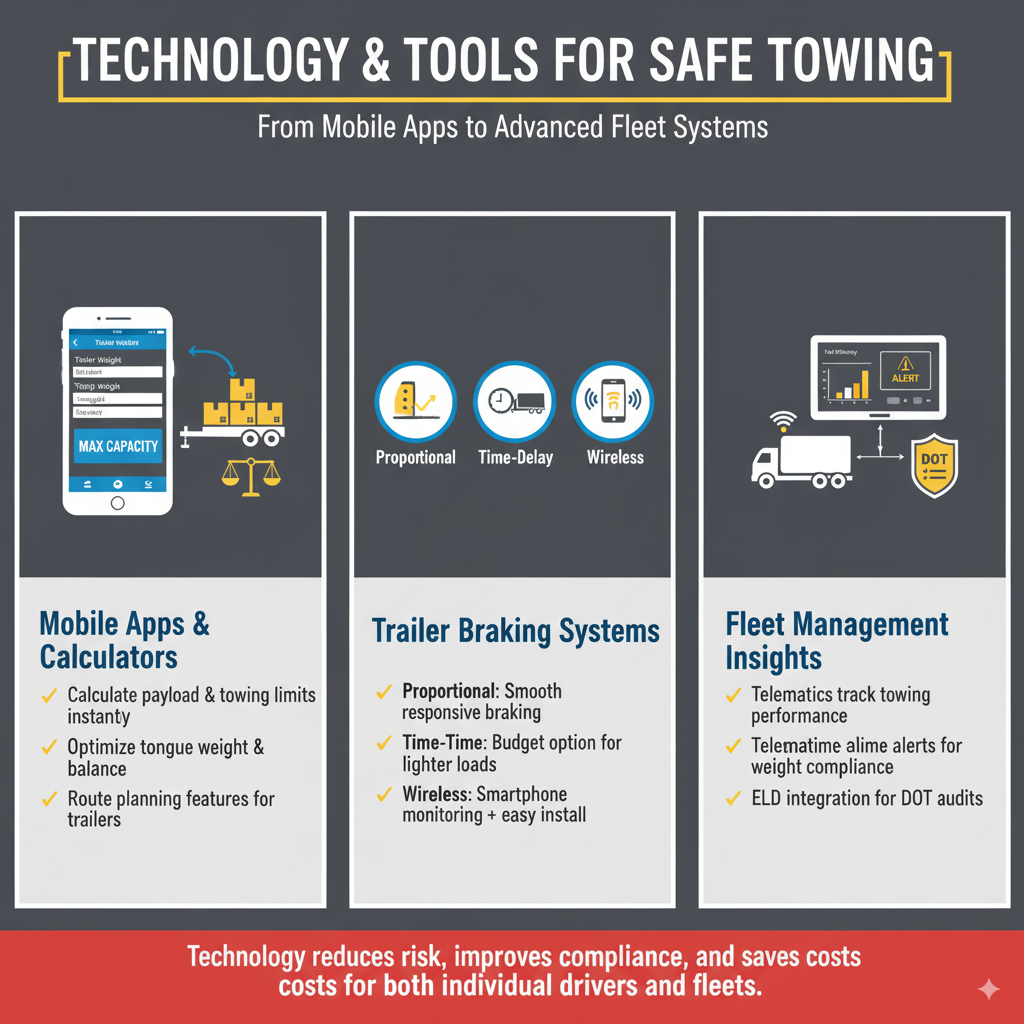
Mobile Apps and Calculators
Smartphone applications help calculate payload capacity, towing limits, and load distribution for various vehicle and trailer combinations. These tools provide quick verification of manufacturer specifications and weight calculations.
Load balancing applications guide proper cargo placement within trailers to optimize tongue weight and stability. Some apps include route planning features that consider vehicle and trailer dimensions.
Trailer Braking Systems
Electric brake controllers provide essential supplemental braking force for trailers exceeding 3,000 pounds. Proportional controllers offer smooth, responsive braking that matches your vehicle’s deceleration rate.
Time-delay controllers provide adequate braking for lighter trailers at lower cost but lack the sophisticated response characteristics of proportional systems.
Wireless brake controllers eliminate complex wiring installations while providing smartphone integration for monitoring and adjustment.
Fleet Management Insights
Commercial fleets use telematics systems to monitor vehicle loading, towing performance, and compliance with weight regulations. These systems provide real-time alerts when vehicles approach weight limits and track fuel efficiency impacts.
ELD integration automatically records towing activities and weight-related compliance data for DOT inspections and safety audits.
Prevention and Preparation
Systematic preparation prevents towing emergencies and ensures safe, legal operation.
Pre-Trip Inspection Checklist
Inspect tires for proper inflation, adequate tread depth, and load rating compliance on both vehicle and trailer. Underinflated tires generate excessive heat and increase blowout risk when towing.
Verify brake system operation, including trailer brake controller calibration and manual activation testing. Check brake fluid levels and pad thickness before departure.
Confirm hitch security, safety chain attachment, and electrical connections. Test all trailer lighting functions and verify proper ground connections.
Route Planning for Heavy Loads
Research bridge weight limits, height restrictions, and truck route regulations along your planned route. Many GPS systems include commercial routing options that consider vehicle and trailer dimensions.
Identify weigh stations, inspection points, and safe stopping locations for rest breaks and equipment checks. Plan fuel stops considering reduced range when towing heavy loads.
Avoid construction zones, steep grades, and congested areas when possible. Consider alternative routes that provide better sight distances and wider lanes for safer towing.
Emergency Kit Essentials for Towing
Carry tire changing equipment rated for your trailer’s weight, including appropriate jacks and lug wrenches. Heavy-duty trailers require specialized equipment that differs from standard passenger car tools.
Pack safety triangles, flares, and reflective vests for roadside visibility during emergencies. Include spare hitch pins, electrical connectors, and safety chain links for field repairs.
Maintain backup communication devices including cell phone chargers and emergency contact information for roadside assistance services familiar with towing emergencies.
Making Smart Decisions Under Pressure
Time pressure and external demands often create situations where careful towing decisions become critical.
Rapid Assessment Questions
Is my vehicle within its rated capacity? Calculate loaded vehicle weight plus trailer weight to verify GCWR compliance. Consider passenger and cargo weight in your calculations.
Do I have the right hitch and equipment? Verify hitch class rating, safety chain capacity, and brake controller compatibility. Mismatched equipment creates dangerous situations regardless of weight calculations.
Is my load secured and balanced? Check cargo distribution, tie-down security, and tongue weight percentage. Improperly loaded trailers cause accidents even within weight limits.
When to Tow and When to Stop
Risk assessment requires honest evaluation of conditions, equipment, and experience levels. Consider weather, traffic, route complexity, and your comfort level with the specific load.
Professional alternatives may provide safer, more cost-effective solutions for challenging tows. Commercial towing services near Benton Harbor, MI specialize in heavy equipment transport and offer expertise that prevents accidents and equipment damage.
Specialized transport companies handle oversize loads, delicate equipment, and high-value cargo with equipment and permits that individual operators cannot practically obtain.
Conclusion & Expert Recommendations
Understanding your maximum weight you can tow requires systematic evaluation of vehicle ratings, load characteristics, and operating conditions. Success depends on accurate calculations, proper equipment, and conservative decision-making that prioritizes safety over convenience.
Your Maximum Tow Weight Action Plan
Step 1: Know your vehicle ratings. Locate and record your GVWR, GCWR, and GAWR from official sources. Calculate your actual available capacity based on loaded vehicle weight.
Step 2: Match the right hitch and trailer. Select equipment rated for your maximum anticipated load with appropriate safety margins. Install brake controllers and safety systems before they’re needed.
Step 3: Distribute weight safely and legally. Balance cargo for proper tongue weight and load distribution. Plan routes that accommodate your vehicle and trailer combination.
Building Long-Term Towing Confidence
Invest in proper training and safety equipment rather than learning through expensive mistakes. Many community colleges and RV organizations offer towing courses that build skills and confidence.
Maintain your tow vehicle regularly with emphasis on cooling systems, transmissions, and brake components. Towing places additional stress on these systems that requires preventive maintenance.
Partner with trusted service providers who understand towing requirements and can provide emergency assistance when needed. Establish relationships with mechanics and towing services near 1303 M-139, Benton Harbor, MI 49022, United States before emergencies arise.
Remember that knowing your maximum weight you can tow is just the beginning. Safe towing requires ongoing attention to equipment condition, load management, and driving techniques that protect you, your cargo, and other road users. When in doubt, choose conservative limits and professional assistance over risky decisions that could result in accidents, equipment damage, or legal consequences.