
No one gets behind the wheel expecting to be in an accident. But across Van Buren County every year, thousands of drivers face exactly that reality — on I-94 near Exit 60, on a fog-covered stretch of M-40 south of Paw Paw, on a deer-heavy county road near Decatur or Lawrence, or even in a parking lot on Kalamazoo Street in downtown Paw Paw. When it happens, the decisions you make in the first few minutes have a direct impact on your safety, your legal standing, and your insurance claim.
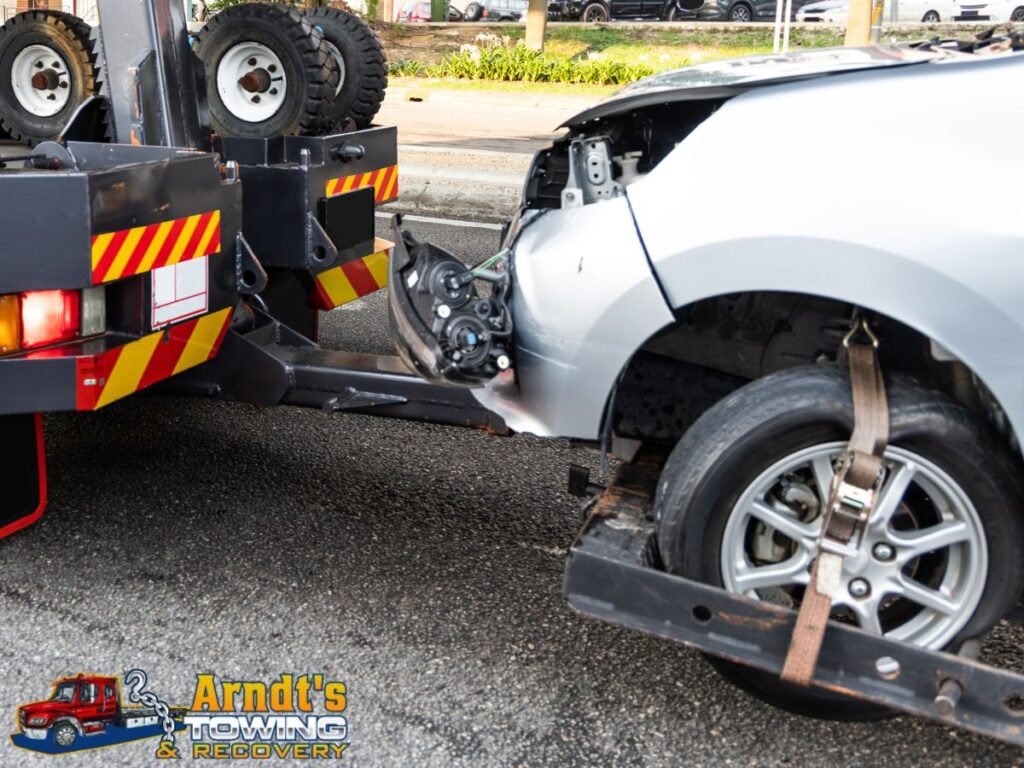
This guide covers everything Van Buren County drivers need to know: what Michigan law requires you to do, how to document the scene correctly, how to choose the right towing company, and how to protect yourself from predatory practices that are far more common in post-accident situations than most drivers realize. And when you need a tow — request Arndt’s Towing And Recovery by name: (269) 655-4123, available 24 hours a day from our base at 43910 30th St, LOT 12, Paw Paw, MI 49079.
Step 1 — Check for Injuries and Call 911
Safety Is the First and Only Priority
The moment your vehicle comes to a stop after an impact, your first action is always the same: check yourself, your passengers, and any other parties involved for injuries. Do not move anyone who complains of neck or back pain — spinal injuries can be worsened by movement. Call 911 immediately if:
- Anyone in any vehicle is injured — even if they say they are “fine” (adrenaline masks pain)
- A vehicle is blocking a travel lane on I-94, M-40, Red Arrow Highway, or any active road
- There is a fire, fluid leak, or chemical hazard
- The accident involved a pedestrian, cyclist, or motorcyclist
The Van Buren County Central Dispatch (911) will route your call to the appropriate responders — Van Buren County Sheriff’s Office for county road incidents, Michigan State Police — Paw Paw Post for state highway and I-94 incidents, and Paw Paw Police Department for accidents within city limits.
When 911 Is Not Required
For very minor accidents — a low-speed parking lot contact with no injuries and minimal visible damage — you may not be legally required to call 911. However, it is always recommended to have a police report as a record for insurance purposes, especially in cases where the other party’s account of events may differ from yours later.
Step 2 — Move Your Vehicle Under Michigan’s Move-It Law
What Michigan MCL 257.618 Requires
Michigan’s Move-It Law (MCL 257.618) is one of the most important laws every Van Buren County driver should know. It states that if a vehicle involved in a crash is drivable and no one has been seriously injured, all drivers involved are legally required to move their vehicles out of the active travel lane to the nearest safe location — a shoulder, an emergency pull-off, a nearby parking lot, or a side street.
Failure to comply is a civil infraction under the Michigan Vehicle Code and can result in a fine. More importantly, a stationary vehicle in a travel lane on I-94 or M-40 is one of the most dangerous post-accident hazards on Michigan roads — the risk of a secondary collision from an inattentive driver is very real, especially at night or during poor weather.
Where to Move in the Paw Paw Area:
- I-94 — pull fully onto the right shoulder or proceed to the Exit 60 off-ramp if the accident occurs near the interchange
- M-40 in Paw Paw — move to any available business driveway, parking lot, or the wide gravel shoulder south of the Paw Paw River bridge
- Red Arrow Highway (M-43) — move to the shoulder or into a gas station or business parking area
- Downtown Paw Paw (Kalamazoo Street) — move to a side street such as Gremps Street or Hazen Street off the main corridor
If your vehicle is not drivable after the accident, do not attempt to move it. Turn on your hazard lights, stay safely clear of traffic, and call Arndt’s Towing immediately at (269) 655-4123 for emergency towing.
Step 3 — Document the Scene Thoroughly
What to Photograph Before Anything Moves
Modern smartphones have made post-accident documentation dramatically more effective — but most drivers still don’t capture everything they should. Before any vehicle is moved (if safe to document first) or immediately after moving to a safe location, photograph:
Vehicle Damage:
- All four corners of your vehicle, even areas that appear undamaged
- Close-ups of all impact points, broken glass, deployed airbags, and fluid leaks
- Interior damage including dashboard, steering wheel, and seat damage
Scene Documentation:
- Road conditions — ice, wet pavement, debris, potholes, construction signs
- Traffic control devices — stop signs, traffic lights, speed limit signs, yield markings
- Skid marks and debris fields — capture these before they are driven over or cleared
- Position of all vehicles before they are moved — this establishes the point of impact
- Weather conditions — especially important for winter accidents on I-94 or deer strike documentation on rural Van Buren County roads
Other Party Information:
- Driver’s license (front and back)
- License plate (all vehicles involved)
- Insurance card (company name, policy number, expiration)
- Vehicle VIN (visible through the windshield on the driver’s side dashboard)
Step 4 — Exchange Information and Know What Not to Say
What You Must Exchange After a Michigan Crash
Under Michigan Vehicle Code MCL 257.619, all drivers involved in a crash must exchange:
- Full legal name and home address
- Driver’s license number
- Vehicle registration number
- Insurance company name and policy number
Provide this information to the other driver(s), any responding law enforcement officer, and retain a copy for yourself.
What You Should Never Say at the Scene
This is one of the most critical and most violated rules after an accident:
Do not admit fault — not even casually.
Saying “I’m so sorry, I didn’t see you” or “I think it was my fault” at the scene can be used against you in an insurance claim or legal proceeding even if the accident was ultimately determined to be the other party’s fault. Stick to factual descriptions of what happened — “I was traveling northbound on M-40 when the impact occurred” — and let investigators and insurance adjusters determine fault based on evidence.
Step 5 — Call Arndt’s Towing And Recovery for Post-Accident Towing
Your Right to Choose Your Own Tow Company in Michigan
This is something many Van Buren County drivers don’t know: under Michigan law, after an accident you have the right to choose your own towing company. This is known as consent towing — you, the vehicle owner, give consent for a specific operator to tow your vehicle. If police dispatch a tow company without your consent (called non-consent towing), this is typically reserved for situations where the vehicle is blocking a travel lane and creating an immediate hazard and the owner is unavailable or incapacitated.
Exercise your right. Call Arndt’s Towing And Recovery at (269) 655-4123 and request us by name. Doing so ensures you get a locally licensed, reputable Van Buren County operator — not an unknown subcontractor who may charge excessive storage fees or route your vehicle to an inconvenient impound lot.
The Predatory Towing Problem in Michigan — What to Watch For
Post-accident scenes attract a practice known as predatory towing (sometimes called “chasing” or “scouting”), in which unlicensed or opportunistic tow operators arrive uninvited at accident scenes and pressure distressed drivers into signing authorization forms — then charge inflated towing and daily storage fees that can quickly reach hundreds or thousands of dollars. Michigan has taken legislative steps to address this, but it remains a real risk. The safest protection is simple: always call your tow company directly and do not sign authorization for any operator you did not call yourself.
For our complete breakdown of what professional towing should look like — and how to tell the difference — read our post on why professional towing matters and our article on whether professional towing damages cars.
What Arndt’s Post-Accident Towing Covers
Once on scene, our certified operators will:
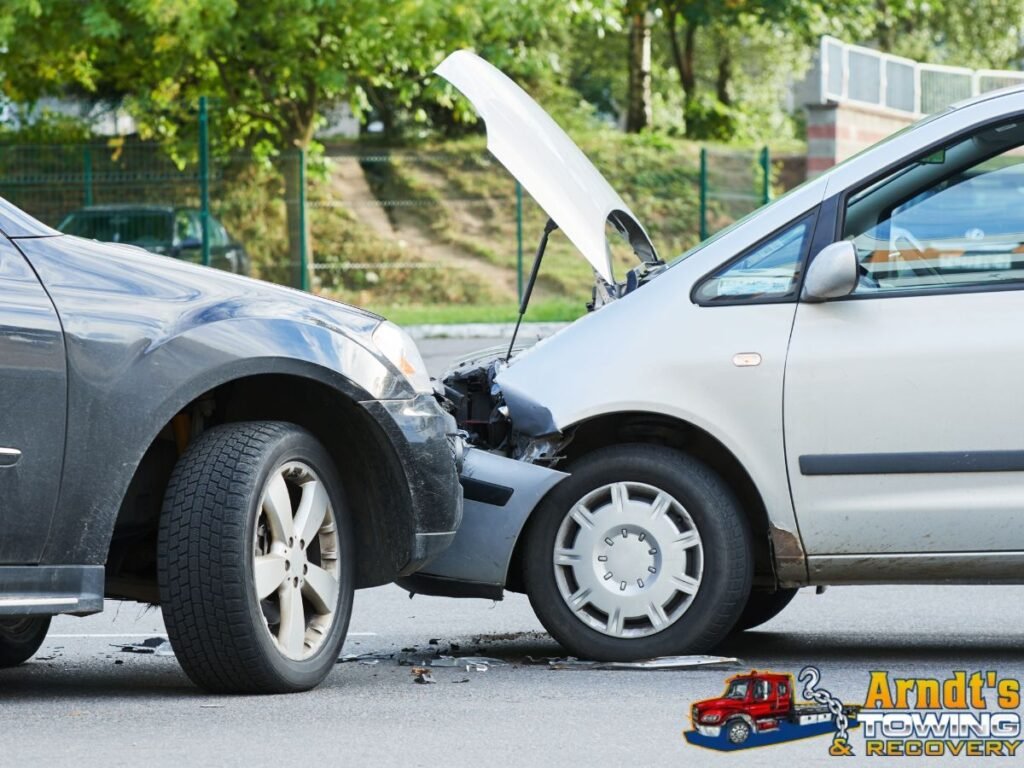
- Assess the vehicle for safe towing — checking drivetrain, fluid leaks, tire condition, and suspension damage
- Select the right equipment — most post-accident vehicles require a flatbed tow to avoid additional damage during transport; see our guide on flatbed vs. wheel-lift towing to understand why
- Transport your vehicle to your preferred destination — your home, your chosen repair shop in Paw Paw, Mattawan, or Kalamazoo, or an insurance-approved repair facility in Van Buren County
- Provide a service receipt with full details for your insurance claim
If you are uncertain whether you need to be present when your car is towed, or what information you need to provide for towing, both guides are available on our blog.
Step 6 — File a Michigan UD-10 Traffic Crash Report
When You Are Required to File
Michigan requires a UD-10 Traffic Crash Report to be completed when an accident involves:
- Any personal injury or fatality
- Property damage of $1,000 or more (which in today’s repair costs is almost any collision)
If a law enforcement officer responds to your accident, they will file the UD-10 on your behalf. If no officer responds — common for minor accidents in rural Van Buren County areas where response times may be longer — you are responsible for filing the UD-10 yourself.
The form can be submitted to:
- Van Buren County Sheriff’s Office — 205 S. Kalamazoo St., Paw Paw, MI 49079
- Michigan State Police — Paw Paw Post — for incidents on state highways and I-94
- Online via the Michigan State Police UD-10 submission portal
Filing within 10 days of the accident is the standard guideline. Keep a copy for your insurance records.
Step 7 — Notify Your Insurance Company
Michigan’s No-Fault Insurance System
Michigan operates under a no-fault auto insurance system, meaning your own insurance company pays for your medical expenses and certain vehicle damage regardless of who caused the accident — up to the limits of your policy. Michigan drivers are required by law to carry Personal Injury Protection (PIP), Property Protection Insurance (PPI), and Residual Liability Insurance.
Contact your insurance company as soon as possible after the accident — ideally the same day. Provide:
- Date, time, and location of the accident
- Photos of vehicle damage and the scene
- Police report number (if applicable)
- UD-10 report number
- Towing receipts from Arndt’s Towing And Recovery
- Contact information for all involved parties
For a full breakdown of typical post-accident towing costs in Van Buren County that you may need to submit for reimbursement, see our car towing cost guide.
Seasonal Accident Hotspots in Van Buren County — Where Crashes Are Most Likely
Winter: I-94 and M-40 Ice Corridors (November – April)
I-94 between Exit 56 and Exit 66 is Van Buren County’s highest-volume road and its highest-risk winter accident corridor. Lake-effect snow and black ice form rapidly on this unshielded stretch, and the high posted speed (70 MPH) means accidents here are often serious. The M-40 overpass bridge deck at the Exit 60 interchange freezes earlier and stays frozen longer than surrounding pavement — a fact that catches many unfamiliar drivers off guard. See our winter towing tips for Michigan roads for full seasonal preparation guidance.
Fall: Deer Strike Zones on Rural County Roads (October – December)
Van Buren County’s rural road network passes through thousands of acres of wooded terrain where white-tailed deer cross at dawn and dusk during fall rut season. The highest-risk corridors include:
- M-40 South between Paw Paw and Lawrence — wooded both sides, minimal lighting
- County Road 653 and M-51 near Decatur (49045) — deep rural terrain
- Territorial Road and County Road 681 near Bangor (49013) — agricultural woodland edge
Michigan comprehensive auto insurance covers deer strikes — they are not treated as at-fault accidents. Document the scene fully, including the deer if possible, and call Arndt’s for post-accident towing if needed.
Summer: Tourist Season Traffic on Red Arrow Highway and Blue Star Highway (June – September)
Red Arrow Highway (M-43) and Blue Star Highway (M-140) carry a massive surge of out-of-town visitors from Memorial Day through Labor Day heading to South Haven beaches, Van Buren County wineries near Lawton, and Kal-Haven Trail. Unfamiliar drivers, distracted navigation, bicycle and pedestrian traffic near beach access points, and the annual Paw Paw Wine & Harvest Festival in early September all contribute to elevated accident risk during this season. Arndt’s light-duty and flatbed towing teams are at full capacity through the entire summer season.
Year-Round: Downtown Paw Paw Intersections
Locally, the intersection of Kalamazoo Street and Michigan Avenue, the M-40 / Red Arrow Highway interchange near Paw Paw, and the heavy commercial corridor along Red Arrow Highway at the edge of town see year-round fender-benders and parking lot incidents. For minor accidents in Paw Paw’s downtown core, Arndt’s wheel-lift towing provides fast, minimally disruptive vehicle removal from congested areas.
Frequently Asked Questions — Car Accidents in Paw Paw, MI
Do I need to be present when my car is towed from an accident scene?
Not always — our detailed guide covers exactly when your presence is required and when it is not: Do I need to be present when my car is towed?
Can Arndt’s tow any vehicle type from an accident scene in Van Buren County?
Yes. We handle cars, trucks, motorcycles, RVs, buses, limousines, and heavy-duty commercial vehicles — with the right equipment dispatched for each vehicle class.
What if the other driver doesn’t have insurance?
Michigan’s no-fault system means your own PIP coverage handles medical costs regardless. For vehicle damage from an uninsured driver, Michigan law provides a Michigan Assigned Claims Plan through the Michigan Automobile Insurance Placement Facility (MAIPF). Consult your insurance agent for specific guidance on your policy.
How do I find out how long it will take Arndt’s to arrive at an accident scene?
Call us directly at (269) 655-4123 for a live ETA based on your location. You can also read our general guide on how long it takes for a tow truck to arrive for typical Van Buren County response time ranges.
Should I move my motorcycle off the road after an accident?
Only if it is safe to do so and you can move it without risk of injury to yourself or further damage to the bike. For all motorcycle post-accident situations in Van Buren County, call Arndt’s for specialized motorcycle towing — our team uses proper soft-rigging and bike-specific loading to prevent further damage during transport.
After Any Accident in Van Buren County — Arndt’s Is One Call Away
The moments after a car accident are disorienting and stressful. Having a plan — and having the right local towing team already saved in your phone — makes every step that follows faster, calmer, and safer. Arndt’s Towing And Recovery is the Van Buren County team that shows up at 2 AM in a snowstorm on M-40, at a summer fender-bender on Blue Star Highway in South Haven, and at every type of crash in between — because that’s what it means to be a locally rooted community business.
Save this number today. Share it with your family. Put it in your glove box.
📍 Arndt’s Towing And Recovery 43910 30th St, LOT 12, Paw Paw, MI 49079 📞 (269) 655-4123 🌐 arndtstowingandrecovery.com ⏰ Open 24 Hours — 7 Days a Week, 365 Days a Year 🗺️ Find Us on Google Maps
Read more guides and local tips on the Arndt’s Towing blog, explore our full towing and roadside services, and learn about the team that has been serving Paw Paw and Van Buren County, Michigan.
Arndt’s Towing And Recovery serves all accident recovery and post-crash towing needs across Van Buren County, Michigan — including Paw Paw (49079), Mattawan (49071), Lawrence (49064), Lawton (49065), Decatur (49045), Bloomingdale (49026), Gobles (49055), Hartford (49057), Bangor (49013), South Haven (49090), and all surrounding townships in Southwest Michigan.